
Since the beginning of the year, signals directed toward Solino have multiplied. On March 26, the Minister of Planning and External Cooperation, Sandra Paulemon, received representatives of the “Retour au Quartier – Solino” project, following a roadmap outlined by Prime Minister Alix Didier Fils-Aimé. On April 17, an interministerial delegation led by the Minister of Youth, Sports, and Civic Action, Pythagore Dumas, toured the area accompanied by officials from DINEPA, the Port-au-Prince City Hall, and Civil Protection to assess damage and guide interventions. In the press, figures are beginning to circulate: a thousand homes to be rebuilt, several thousand young people to be trained in construction trades. Streetlights have been announced. Government will exists. That is at least something.
The question remains that no visit, announcement, or press release has yet clearly posed: do we know what we are undertaking?
The temptation is to answer yes because the vocabulary seems familiar. Haiti has rebuilt after disasters, or rather attempted to, in 2010 and the following years. Post-disaster reconstruction is a well-mapped field with its manuals, indicators, specialized donors, and proven doctrine. Damage is assessed, resources are mobilized, rebuilding occurs, services are restarted, and the return of populations is supported. The grammar is known. The problem is that this grammar does not apply to what happened to Solino. An earthquake, a flood, a fire: these events share a decisive characteristic. They strike a fabric, but they leave intact what is not made of stone and tin. Neighbors remain neighbors. The baker still knows whom to credit. The tap-tap driver still knows the names of the children he saw grow up. The tacit contract of coexistence that held the neighborhood together before the disaster persists amidst the rubble. Cement, when it returns, rests on a substrate that has survived. It is this invisible continuity that makes reconstruction possible in the usual sense. It is not a creation; it is a repair.
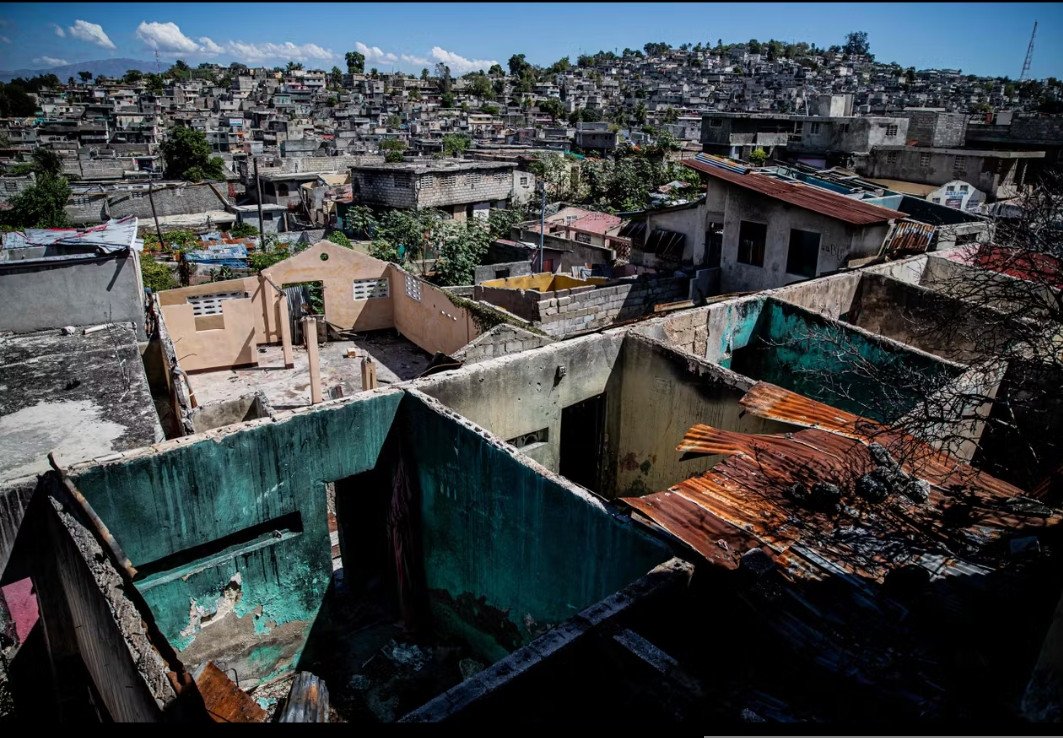
Solino is not in this situation. What happened to it is not a disaster; it is an eviction. Organized violence, led by the Viv Ansanm coalition after nearly two years of pressure, drove residents from their homes, burned buildings, looted property, and step-by-step erased the material traces of collective life. But it did more. It dispersed the people. It broke neighborhood chains. It forced everyone to leave alone, quickly, without warning others, because warning meant putting oneself in danger. When we envision the return today, it is not a sleeping neighborhood we seek to awaken. It is a scattered population of whom no one exactly knows who they are, where they live, or what they want.
We do not have, in common language, a word to describe what happened. “Forced displacement” sounds too administrative, “cleansing” is politically charged, “eviction” remains too civil. This lexical deficiency is not a detail. As long as a phenomenon is not properly named, the response opposed to it remains, by default, the one applied to the closest well-named phenomenon. And the closest well-named phenomenon in Haitian urban matters is the natural disaster. We draw the grammar from it, apply it, and fail to see what it misses.
What it misses is that the raw material for Solino’s reconstruction is not primarily concrete. It is the human fabric that has been undone. This is not a sentimental question; it is an operational one. Rebuilding a thousand homes for a population of whom we do not yet know who will want to return, how many, and under what conditions, is to run the documented risk of producing a dormitory-neighborhood that its own inhabitants will leave as soon as they can. This has been seen elsewhere, in comparable contexts, whenever reconstruction has been treated as a housing supply problem.
Something must be added that further complicates the reading: the Solino of before was not an optimum to be restored. It was already a zone of concentrated poverty, anarchic construction, absent basic services, water that didn’t come, flickering electricity, and schools that barely functioned. The absence of a reliable land registry, the occupation of non-buildable land, and overcrowding on slopes and ravine edges had patiently produced, over decades, a vulnerability for which gang capture was the consequence rather than the cause. A territory without documented property is a territory whose use no one can legally defend. A territory where the State never passes is a territory where someone else will eventually organize the rules. What we call Solino to be rebuilt today is, in reality, a failing balance that finally gave way, rather than a healthy order brutally interrupted.
This changes the question. “Rebuilding,” in the literal sense, would amount to restoring the configuration that produced the fall. This is obviously not what anyone wants, even if it is often what happens because the path of least resistance is to rebuild identically what memory keeps and what claimants demand. The alternative, “refounding,” carries its own risks: a refounding decided from above, with an engineer’s plan and authoritarian reconfiguration of the urban fabric, opens the door to what Beirut experienced with Solidere in the 1990s—a rebuilt center from which former inhabitants were gradually excluded, a space materially impeccable and socially emptied. The story is not Haitian, but the warning is.
And this warning carries even more weight because Solino is not an isolated neighborhood. It is a sample of that constellation of popular neighborhoods that have served the Haitian political economy for at least three decades. Recent documented history shows repeated links between the territorial dynamics of popular neighborhoods and the political or criminal uses made of them. Jamaica formalized this model to the point of giving it a name, “garrison constituencies,” whose academic literature has meticulously reconstructed the genealogy. Haiti has not had this level of formalization, but the phenomenon of “bases,” the employment of youth from popular neighborhoods in mobilization or protection roles, and then the emergence of territorial gangs like Grand Grif, all belong to the realm of what can be cited without guesswork.
In this framework, reinvesting in Solino with some equipment and a relaunch discourse is to run the risk of unknowingly renewing the arrangement that produced the fall. It is putting the zone back into sufficient working order for life to resume without touching the structural conditions that made it available ground for whoever decided to use it. Cosmetic reconstruction does not preserve peace; it weakens it by giving it the appearance of recovery. It allows political actors to turn the page even though the page has not been written.
Because there is a phenomenon, documented by Charles Tilly over a long period, that must be named: the routinization of collective violence. With each cycle, the threshold of what is admissible rises. The zenglendos of the 1990s still operated in a logic of individual predation; the chimè politicized violence but contained it within clientelistic frameworks; Viv Ansanm crosses an additional step—in coalition, in lasting territorial control, in frontal challenge to sovereignty. At each step, what was unthinkable at the previous step becomes the new baseline. This is not a psychological fatality; it is a phenomenon of social memory: the next generation operates from the precedent, not from the origin. If Solino is rebuilt without refounding the contract that governs it, the next cycle, if it occurs, will start from Viv Ansanm as the norm, not the exception.
This is why what Solino needs, before any program, budget, or numbered announcement, is a method. A method that does not separate diagnosis from action, that does not treat “what needs to be understood” and “what needs to be done” as two successive steps but as two sides of the same gesture. This method unfolds in five articulated layers: physical, land tenure, demographic, economic, and institutional—each carrying both its own observation and its operational translation, each calling for the next.
The first layer is physical, and it is also the most immediately decisive. Above all, a fine mapping of the terrain must be established: topography, slopes, soil behavior, flood zones, and the load-bearing quality of the remaining buildings. Solino before the gangs already had a significant portion of its buildings constructed on land that should never have been built upon. This mapping does not lead to a filed report; it leads immediately to a decision: what must be cleared because it is rebuildable elsewhere, what must be reconfigured because it is repairable with structural reinforcement, and what must be abandoned as non-buildable zones and transformed into public spaces or roads. This decision is not solely technical; it touches on the memory of places and belongings, and it requires consultation with inhabitants, which is itself an act of social reconstruction. Boldness without mapping is brutality. Mapping without boldness is management. The first layer poses both together.
The second layer is land tenure, and it is in this layer that much of what differentiates cosmetic reconstruction from foundational reconstruction hinges. It involves establishing who occupied what, by what title, and since when. Official titles, possessions documentable by testimony, pre-existing occupations recognized by the community. But this observation is meaningless if it is not followed by systematic land regularization, with registration at the DGI, recognition of old uses, and issuance of enforceable titles. Peru conducted a comparable operation with COFOPRI in the 1990s, demonstrating that massive regularization is feasible in a few years. For a population just driven out, who lost even the papers proving their administrative existence, a property title is more than a legal document. It is the public recognition that people lived there, built there, and belong to that place. It makes the holder legally defensible, economically visible, and fiscally identifiable. It is the key that unlocks all that follows.
The third layer is demographic, and its specific difficulty is greater than it appears. Who has already returned, who wants to return, who has permanently resettled elsewhere? The reference population is not gathered in one camp where they could be counted; they are scattered across a myriad of makeshift arrangements. A targeted census, conducted in collaboration with grassroots organizations, churches, and schools that have maintained contact with the displaced, is the only way to adjust the reconstruction supply to real demand. This census is not just a statistic; it is a calibration. If the population wanting to return is 300 households and not 1,000, building for 1,000 creates the dormitory-neighborhood no one wanted. Observing to calibrate, calibrating to decide, in one single gesture.
The fourth layer is economic, and it carries the reconstruction of the productive fabric in the most concrete sense. We must map the previous survival chains and understand how workshops and businesses functioned. But this mapping only matters if it authorizes an active structuring decision, playing out on two levels: the industry level and the financial infrastructure level.
On the first level, construction trade training reproduces the classic failure of Haitian vocational programs if it happens in a classroom months before youth look for non-existent jobs. The alternative is to think of the construction site itself as the school: Solino’s youth rebuild Solino, supervised by master builders. The reconstruction becomes the certification, and in doing so, they remake the neighborhood as their own. Material action produces social bonds. For acquired skills to produce lasting employment, cooperatives or SMEs must be formed, capable of bidding on public contracts beyond Solino. This requires legal structuring, partnerships for materials, and an enforceable local content clause in every public contract. Without it, training is an expense; with it, the industry exists because it has the orders to deploy.
On the second level, the financial infrastructure, Solino’s economic reconstruction can rely on digital financial integration. The fried food vendor doesn’t need a classic bank account; she needs a QR code on her stall. Customers pay with their phones. Money arrives in a mobile wallet that can immediately pay wholesalers or utility bills. Haiti already has the technical infrastructure with MonCash and NatCash; what is missing is the density of use on a neighborhood scale. Each transaction leaves a trail, constituting a history. Six months of documented daily income history allows for a micro-credit calibrated to real flow, supplemented by land titles as collateral. The risk profile inverts: the more she transacts, the more visible she becomes to the financial system. And this infrastructure produces a side effect: gang economies rely on untraceable cash. A neighborhood where payments are mostly digital is a neighborhood where daily extortion loses efficiency.
Before the final layer, we must name what holds the previous four together as a political promise: the symbolic dimension. Medellín, in the early 2000s, installed monumentally designed buildings in its most degraded areas. The “Library Parks” assumed a clear thesis: the most beautiful public buildings must be where people have historically received the worst. This is a symbolic reversal. In Solino, this could take the form of a high-quality cultural and educational center—a place where neighborhood children prepare for exams in the same conditions as those in Pétion-Ville. It is the material signal that another spatial hierarchy is possible.
The fifth layer is institutional, closing the loop. Who integrates the previous four? At what level of the State can arbitration occur when land tenure contradicts physical layers? A diagnosis without integrating authority remains just a document, and in Haiti, documents get filed away. But this layer also demonstrates what a refounded State looks like at a neighborhood scale: the visible fiscal cycle. Land titling creates owners. Owners, made visible by digital banking, become non-punitive taxpayers. A low rate compensated by a wider base allows for property taxes and business licenses. Here, the contract becomes tangible: a portion of this revenue is earmarked for the neighborhood itself in visible services—schools with canteens, maintained roads, trash collection, health clinics. The citizen sees their tax return. This visibility legitimizes the State.
Security must then be thought of not as presence but as architecture and contract. The alternative to failed models is making security presence one of the terms of an explicit, renewable local pact: residents commit to reporting and cooperating in exchange for guarantees on the permanence of protection. This pact is only a co-responsibility mechanism if it fits into an architecture linking police, intelligence, and justice. Without this, territorial re-confiscation by gangs is the most likely trajectory.
This article does not claim to be an operational roadmap or a public policy note. It is a method proposed for discussion. None of the current Haitian devices, taken in isolation, are structured to lead an integrated operation of this nature. Each ministry will fill its execution reports, but the integration—the thing itself—will have taken place nowhere. It is not a lack of will, but a lack of a framework.
This framework can be invented by thinking about Solino. Or it can not be, in which case Solino’s reconstruction will only be the interval between two destructions. The difference this time is that the method exists if chosen. This choice is not technical; it is political: whether the State wants to demonstrate it can reappear somewhere lastingly and integrally as a State. Solino can be the example, not by the list of things announced, but by the coherence of what is done, in the order things must be done.
The method is reproducible. Not the figure.