

Alix Didier Fils-Aimé is entering a critical phase of his leadership, as Haiti faces a convergence of security, economic, and social pressures that are rapidly becoming his first major tests in office.
A fragile start to governance
Despite strong backing from the international community, the Prime Minister’s early appointments have raised concerns. Rather than prioritizing technocratic expertise, his cabinet choices appear largely driven by political alliances. This approach may now be tested under intense real-world pressures.
Escalating violence and security setbacks
On the security front, the situation remains alarming. A massacre in Petite-Rivière de l’Artibonite, attributed to armed groups, left at least 16 dead according to police, with other estimates pointing to significantly higher casualties.
The expansion of gang activity beyond Port-au-Prince continues to erode state authority. According to the United Nations, more than 8,100 killings were recorded nationwide between January and November 2025, with a sharp increase in regions like Artibonite and the Centre.
As head of the High Council of the National Police, Fils-Aimé faces mounting pressure to reverse the balance of power. While efforts are underway to strengthen the Police nationale d’Haïti (PNH) and the armed forces, the situation on the ground suggests that gangs still maintain significant operational capacity.
Fuel shock and global pressures
At the same time, Haiti is being hit by external economic shocks. Rising oil prices—linked to escalating tensions involving the United States, Israel, and Iran—are pushing global energy costs higher.
Benchmark crude prices such as Brent crude have surged above $115 per barrel, creating immediate pressure for import-dependent economies like Haiti.
The government has responded by implementing a new pricing framework for petroleum products. As of April 2, 2026:
- Gasoline: 725 gourdes (up from 560)
- Diesel: 850 gourdes (up from 620)
- Kerosene: 845 gourdes (up from 615)
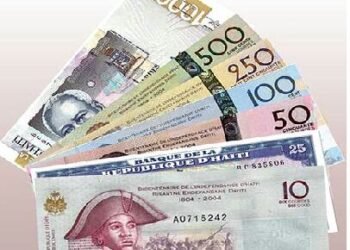
These sharp increases reflect both global price dynamics and the depreciation of the gourde, which is trading around 130 HTG per USD.
The risk now extends beyond price hikes:
- reduced import volumes
- potential fuel shortages
- expansion of the black market
Inflation risks and macroeconomic fragility
The Banque de la République d’Haïti (BRH) has warned that these external shocks could reverse recent progress on inflation, which had declined to 23.5% in January 2026.
Key vulnerabilities include:
- heavy reliance on imported fuel
- exposure to global supply chain disruptions
- pressure on foreign exchange reserves
The potential disruption of strategic routes like the Strait of Hormuz—through which roughly 20% of global energy flows—adds another layer of uncertainty.
A convergence of risks
Fils-Aimé is thus confronting a classic multidimensional crisis:
- Security crisis → mass violence, displacement
- Energy shock → rising fuel prices, fiscal strain
- Inflation pressure → declining purchasing power
These factors are mutually reinforcing, increasing the risk of:
- social unrest
- economic contraction
- political instability
A narrow margin for maneuver
The government’s ability to absorb shocks is limited. Subsidizing fuel strains public finances, while passing costs to consumers risks triggering unrest. At the same time, maintaining political alliances requires resources that may become increasingly scarce.
With elections expected in 2026, political tensions are also likely to intensify.