

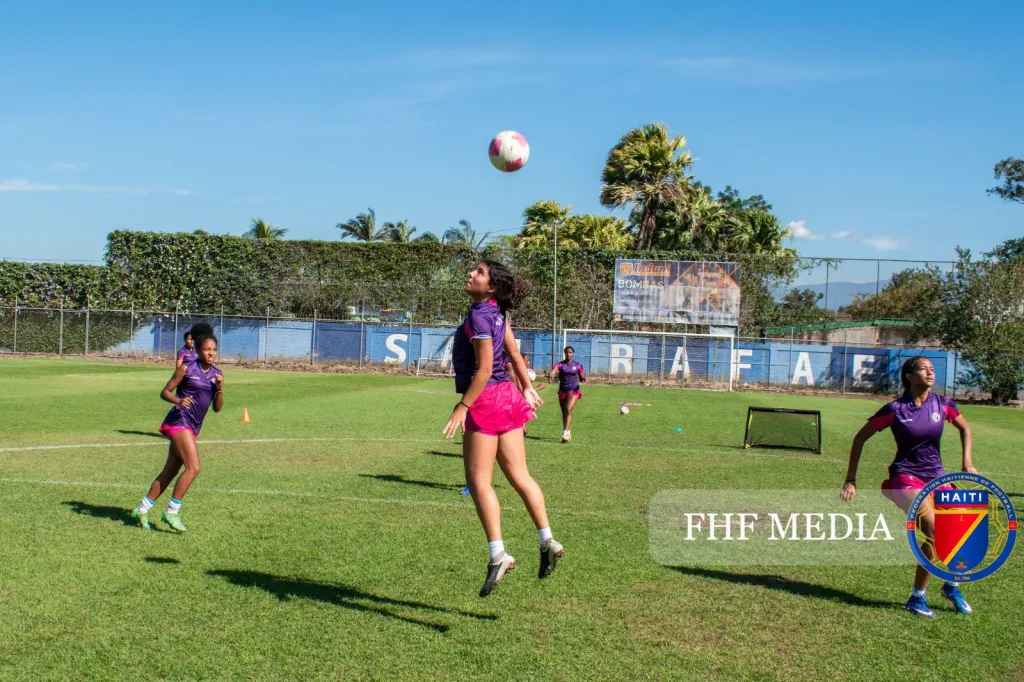
Haiti’s U-17 women’s national team has been eliminated from the qualifiers for the FIFA U-17 Women’s World Cup Morocco 2026 after consecutive defeats to Puerto Rico and the United States. The team played without five key players who were unable to travel due to visa complications, including their captain and starting goalkeeper.
The young Haitian side, known as Les Petites Grenadières, lost 3–1 to Puerto Rico on March 17 and then suffered a heavy 9–0 defeat to the United States on March 19. These results made it mathematically impossible for Haiti to finish among the top two teams in its group, ending its hopes of qualifying for the World Cup scheduled for October and November in Morocco.
Several important players were absent from the squad. Among them were midfielders Kerdina Lamour and Dieunie Love Beaubrun, captain and defender Saraline Acher, starting goalkeeper Guerda Charles, and backup goalkeeper Shama Jean-Baptiste. In addition, members of the Haiti-based coaching staff were also unable to travel after authorities in Costa Rica denied their visa requests.
The situation quickly sparked criticism online. Many fans blamed the Haitian Football Federation (FHF) for failing to secure the necessary travel documents in time.
The disappointment contrasts with a period of relative optimism for Haitian football. In recent months, the national program has seen several positive developments across different teams. However, administrative and logistical challenges continue to affect youth squads.
A similar issue occurred in July 2024 when several Haiti-based players from the U-20 men’s national team were unable to travel to a qualifying tournament in Mexico due to visa problems, which ultimately affected the team’s chances of qualifying for the FIFA U-20 World Cup 2025.
Despite entering the qualifiers with momentum after dominating earlier opponents 18–1 in the opening stage, the U-17 women struggled without their full roster. Defensive organization and midfield coordination were noticeably affected, particularly in matches against stronger opponents.
Many observers believe that a full squad might have produced a different outcome, especially in the match against Puerto Rico, although defeating the United States would still have been a difficult challenge.
Haiti still had one final match in the group stage against Bermuda on March 22, a game played mainly for pride after elimination from the tournament.
Even though the U-17 women’s campaign ends in disappointment, Haiti still has another opportunity to qualify for a youth World Cup this year. The men’s U-20 national team is expected to compete in the next phase of regional qualifiers later in the summer, with the official draw from CONCACAF still pending.
For now, the elimination of the U-17 women highlights a recurring issue in Haitian football: progress on the field often continues to be hindered by administrative and logistical challenges off it.