
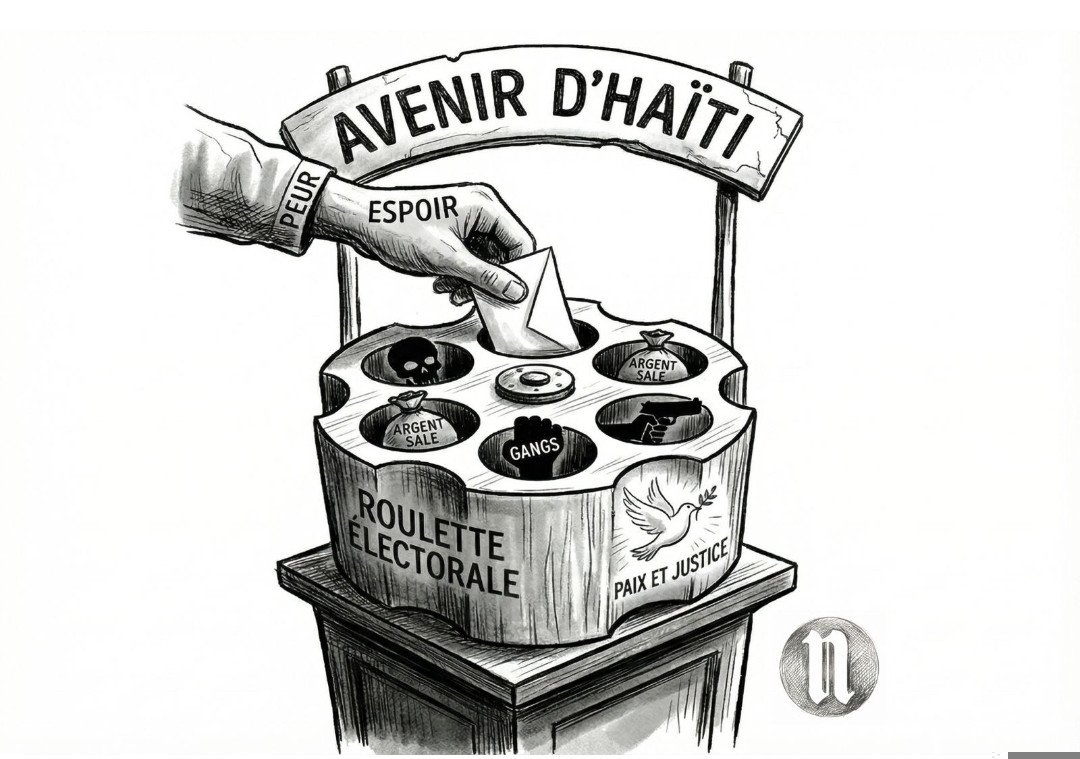
In 2026 or 2027, elections must take place in Haiti. Voters—many of whom abstained massively in previous elections—will have to decide and vote with hope. The hope that the country might finally emerge from its deadlock. But a major issue remains: the political offer, upon closer inspection, is still largely composed of entrenched actors—figures associated with past regimes, opportunists, and architects of chaos. Under new or old labels, these actors—and their backers—still have real chances of being elected.
In a country where hunger is persistent and vote-buying (“votes for 1,000 gourdes”) has shaped so many tragedies, the financial power of corrupt networks will be formidable. Money, as often, will flow freely. No effective barrier exists to prevent illicit funds from financing electoral campaigns.
The likelihood of the same actors renewing themselves is high. This prospect shocks some, while skeptics—accustomed to recurring political disasters—feel confirmed in their darkest predictions. Yet these concerns must be analyzed rationally. For two reasons: they both express and challenge reality. It is now evident—even to the most doubtful—that there exists in Haiti a “system” capable of reproducing itself to maintain the status quo, control power, and preserve privileges.
It is equally clear that this system, in order to protect impunity following calls for accountability—“Where is the PetroCaribe money?”—has contributed to arming gangs and fueling violence. This violence has merged with deeper structural conflicts: competing interests, protection of economic strongholds, expansion of the criminal economy, and Haiti’s use as a drug transit point. Altogether, this has accelerated the symbolic and functional collapse of the state.
The human toll of this constructed chaos is devastating: around 20,000 deaths in five years. During that period, the destruction of assets, businesses, and economic activity has been catastrophic. The system—operating partly outside any ethical or collective framework—has managed to sustain itself, ensuring representation among a shrinking portion of the electorate and even among some actors in the international community.
The risks of maintaining the status quo are well known. If elections—feared by many Haitians—simply reproduce the same leadership, they will amount to a leap into the familiar, a promise of even greater suffering.
This raises critical questions: Where is the leadership capable of articulating a coherent alternative? Who will acknowledge that the hardest challenges lie ahead, diagnose the failed state, and urgently design a new one?
In a country marked by deep and systemic inequalities, progress cannot occur without recognizing the breakdown of the social contract and the need to rebuild it on sincerity and lived reality. Today more than ever, this collective suffering must become the foundation for a new state—one capable of restoring authority, rule of law, justice, and territorial integrity.
Elections that merely reproduce the same patterns—especially the normalization of impunity—risk further discrediting institutions and deepening a crisis of representation that has already evolved into something more profound. These overlapping crises are exploited and monetized by those claiming to represent the people, while the social fabric continues to deteriorate rapidly.
Yet the future must become the subject of a genuine national conversation about reconstruction. This could take shape through a national recovery project validated at the ballot box. However, with a fragmented electorate and the growing dominance of regional political dynamics, the challenge is immense.
Perhaps most concerning is not that harmful actors are mobilizing—it is the passivity, silence, and resignation of those who suffer. There is a lack of credible, audible, and popular alternatives capable of designing and implementing a viable national recovery.
Faced with a deep moral crisis, rebuilding state legitimacy, reconfiguring social solidarity, restoring justice and equity, and reinventing governance and participation are monumental tasks. A serious leadership should remind the country: “Nothing is impossible for Haitians.”
Nearly four decades ago, after the Duvalier dictatorship, people believed in the promise of three words: justice, transparency, participation. These ideals—like order, discipline, and work—must now translate into concrete realities and viable solutions to the country’s existential challenges.
While proposals such as a democratic pact or fiscal reform could help mobilize national energy, no genuine political movement breaking with the forces of chaos has yet emerged. Early signals suggest the persistence of illusion rather than real change. False saviors already have backing, and entrenched networks continue to operate with strategic precision.
If the future is never predetermined, then in the face of fragmentation, hidden forces, and illicit money, Haiti must invent a unity of purpose and vision—for a country whose future can no longer be left to the roulette of elections.