
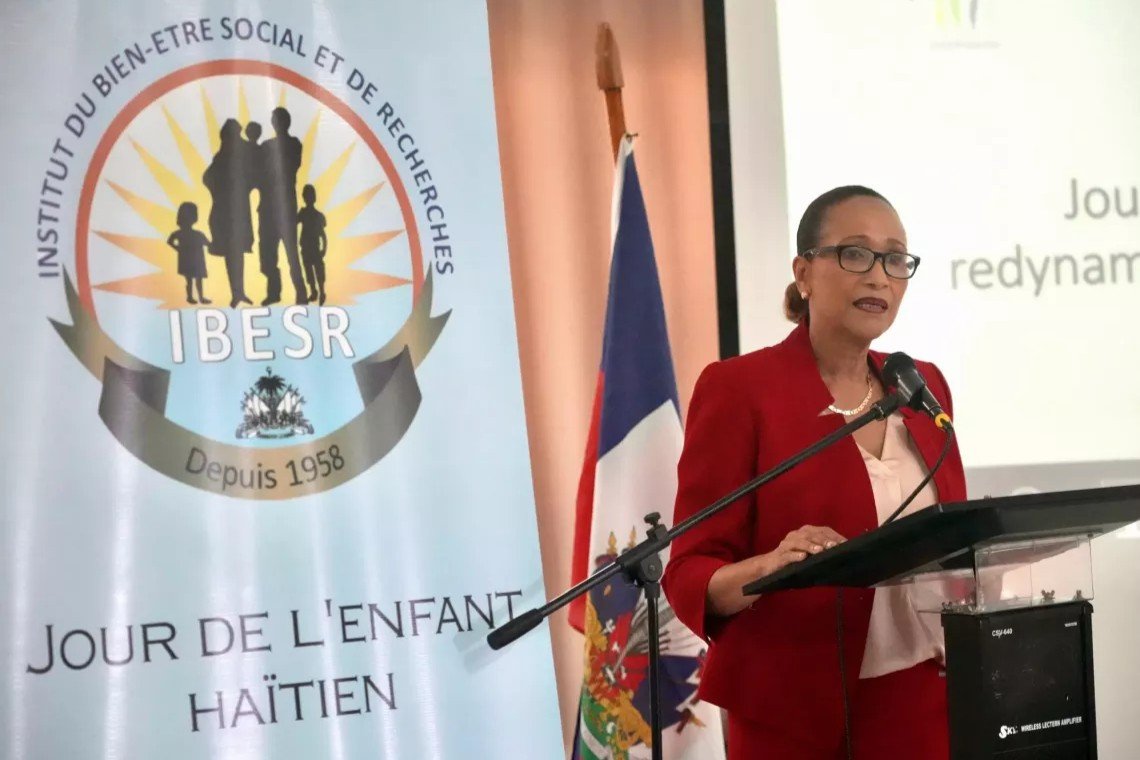
The Institut du Bien-Être Social et de Recherches (IBESR) has issued clarifications regarding its work to protect and reintegrate children recruited by armed groups in Haiti, following an editorial published on March 10, 2026 in Le Nouvelliste by journalist Jean Pharès Jérôme.
According to the institution, it has been actively addressing the issue of children recruited by armed groups for more than three years. A key mechanism in this effort is the Handover Protocol, initiated by IBESR and signed in 2023 by several institutions, including the Ministry of Social Affairs and Labour of Haiti, the Ministry of National Education and Vocational Training of Haiti, the Ministry of Justice and Public Security of Haiti, UNICEF, and other United Nations partners.
This protocol ensures that children associated with armed groups are transferred to child protection services and treated primarily as victims in need of protection, support, and reintegration.
IBESR said several training sessions have been organized for community leaders and local organizations to help prevent recruitment and identify children at risk, with support from UNICEF. A specialized center has also been established to provide psychosocial care and reintegration support for affected children. The facility is funded jointly by the Ministry of Social Affairs, IBESR, United Nations Children’s Fund, and United Nations Integrated Office in Haiti (BINUH).
The agency also collaborates with the Direction de l’Administration Pénitentiaire d’Haïti to support minors leaving the Centre de Rééducation des Mineurs en Conflit avec la Loi (CERMICOL), providing psychosocial assistance and reintegration services according to their needs.
Under the leadership of the Ministry of Social Affairs and Labour of Haiti and IBESR, the Haitian government has inaugurated a reception center in Les Cayes capable of supporting more than 600 vulnerable children, including those previously involved with armed groups.
IBESR also works on family reunification and social reintegration. However, as it does not have the mandate to provide financial subsidies directly, it collaborates with the Caisse d’Assistance Sociale (CAS) and various partners to implement socioeconomic support initiatives.
The institution emphasized that it is not a security intervention body. Operations in areas controlled by armed groups fall under the responsibility of the Haitian National Police (PNH) and its Brigade de Protection des Mineurs (BPM). IBESR’s role remains focused on protection, care, and reintegration of child victims.
Despite the challenging security context in Haiti, the agency said it remains committed to strengthening its work and improving communication with the media to ensure better understanding of its actions. It stressed that child protection is a collective responsibility involving the entire society.