
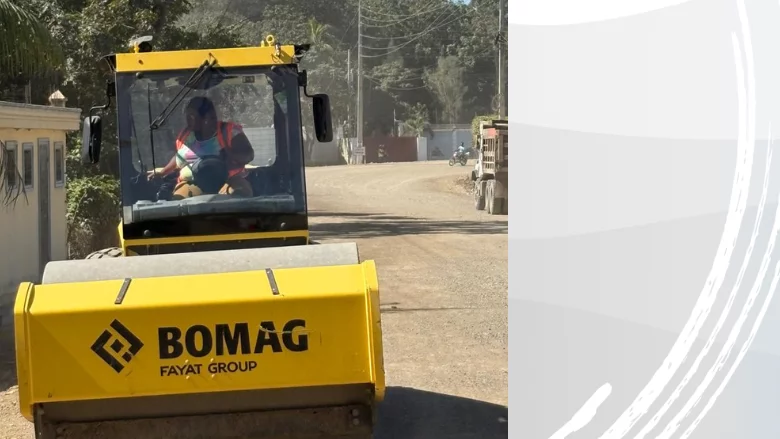
Natacha is a heavy machinery operator for the “SOS Road” project, a 6km artery essential to the connectivity of Cap-Haïtien. Capable of maneuvering excavators and steamrollers with surgical precision, she is the face of a new government and World Bank-backed initiative to integrate women into the formal construction workforce.
Challenging the “Boys’ Club”
Despite 15 years of experience, Natacha admits the road hasn’t been smooth. “Men still hesitate to believe that we can be as efficient as them—or better,” she says. “It leads to frustration, and sometimes even sabotage.”
Her story is a rare exception in a bleak statistical landscape. According to 2023 World Bank gender assessments, Haiti suffers from deep sectoral segregation:
Construction & Transport: Almost exclusively male.
Aviation: Only 28% female representation.
Public Administration: While women make up 33% of the workforce, they hold only 16% of strategic or high-level positions.
A $366 Million Investment in Equality
The shift is being driven by a massive $366 million investment from the World Bank into Haiti’s infrastructure portfolio. The goal is simple: turn human capital into meaningful employment.
“Economic empowerment for women is essential to boost productivity and reduce poverty,” explains Anne-Lucie Lefebvre, World Bank Country Manager for Haiti.
The Strategy for Change:
Corporate Training: Local firms are being educated on gender gaps and the benefits of a diverse workforce.
Incentivized Recruitment: Companies are encouraged to hire women from local communities.
Site Sensitivity: Making construction zones “female-friendly” by addressing safety and basic facilities.
Impact by the Numbers: The “SOS Road” and Beyond
The results of these targeted policies are beginning to show on the ground. Since the SOS Road project launched in October 2025, it has generated 4,209 female-workdays.
Elsewhere, the Resilient Connectivity and Urban Transport Accessibility Project, which is rehabilitating 290km of roads in the South, has achieved even more:
21,379 female-workdays for community-based roles.
53 formal, high-skilled technical positions filled by women.
Legacy and Inspiration
For Natacha Paul, the work is about more than asphalt and gravel. Having worked on private ports and high-security buildings, she now views herself as a mentor.
“I am proud,” she concludes. “I have inspired other women to step up and become heavy machinery operators. We are proving that development in Haiti cannot happen without us.”