
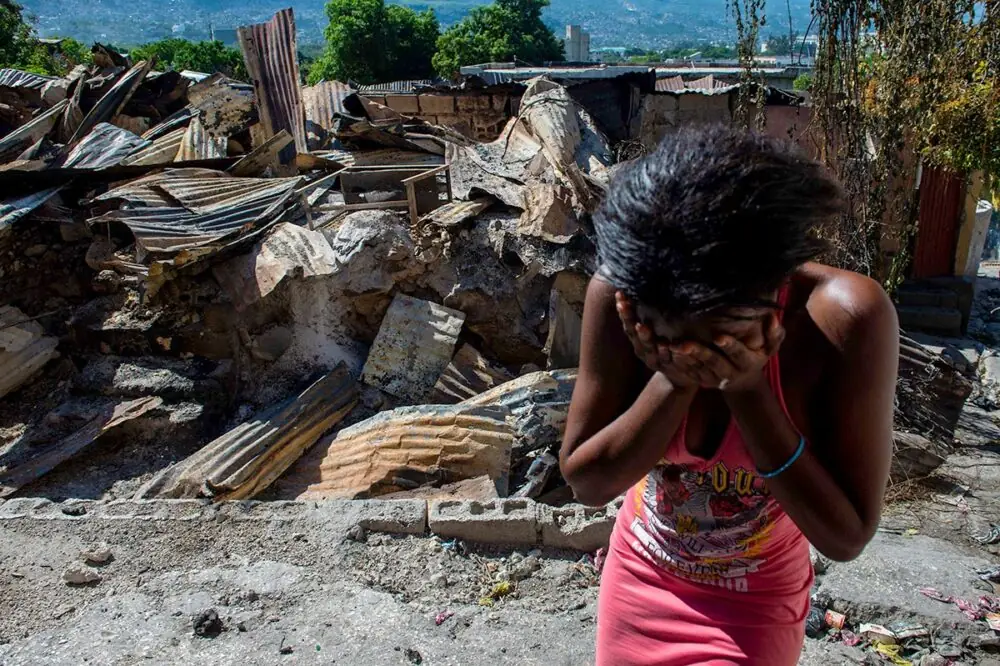
The statistics are harrowing. In 2025 alone, nearly 6,000 people were murdered. Gangs, now employing “scorched earth” tactics, control the vast majority of the capital. According to William O’Neill, the UN’s designated expert on Haiti, the crisis has become a generational catastrophe. “Children are being targeted, recruited, and trafficked,” O’Neill told Justice Info. “Sexual violence has reached unprecedented levels.”
The Political Pivot: Washington’s “Robust” Gambit
The political landscape shifted dramatically on February 7, 2026. After a period of infighting within the Transitional Presidential Council (TPC), the council handed exclusive executive power to Prime Minister Alix Didier Fils-Aimé.
This consolidation was heavily influenced by the Trump Administration, whose Haiti policy has focused on two primary pillars:
Stemming Migration: Preventing a mass exodus of Haitians toward Florida.
Arms Interdiction: Cracking down on the flow of weapons from the U.S. to Haitian gangs.
“The Trump administration has exerted more pressure to stop arms trafficking than we’ve seen in years,” O’Neill noted, citing recent high-profile arrests in Florida and intercepted shipments in Miami.
Private Militaries and the “Drones of Change”
Perhaps the most controversial development is Prime Minister Fils-Aimé’s reliance on Vectus Global, a private military company led by Blackwater founder Erik Prince. Since February 2025, this force has utilized explosive drones against gang strongholds—a tactical shift that has “changed the rules of combat” but raised grave concerns regarding accountability and civilian casualties.
A New Force: From MSS to GSF
In September 2025, the UN authorized the Gang Suppression Force (GSF) to replace the underfunded and largely ineffective Kenyan-led mission (MSS).
Scale: 5,500 personnel (vs. 1,000 in the previous mission).
Mandate: Independent offensive military operations, no longer restricted to just “supporting” the local police.
Tactics: Emphasis on air superiority—using helicopters to bypass gang roadblocks and strike high-density urban zones.
The Judicial Ghost Town
The Haitian justice system is currently a “total mess.” Gangs have occupied major courthouses, burning archives and destroying years of criminal records. To combat this, the TPC has decreed the creation of two Specialized Judicial Hubs:
Financial Crimes Hub: Targeting corruption and the money laundering that fuels gang activity.
Mass Violence Hub: Addressing gang warfare, sexual violence, and mass killings.
These hubs will receive international expertise but remain firmly under Haitian sovereignty—a point of pride for a nation wary of foreign-imposed “hybrid courts.”
The Path Forward: Truth over Retribution?
Experts like Diego Da Rin of the International Crisis Group argue that while military superiority is necessary, it is not a cure. The key lies in Transitional Justice—a system that offers a degree of judicial relief to gang members who lay down their arms and “tell the whole truth” about their political and financial backers.
“There are simply too many perpetrators to try everyone,” O’Neill warns, drawing parallels to post-genocide Rwanda. “We must look at reparations, truth commissions, and accountability mechanisms that are acceptable to the local population.”
For Haiti, the goal is no longer just “security”—it is the dismantling of the toxic link between the political elite and armed violence. Without it, the “scorched earth” will never grow back.
| Actor | Role/Objective | Key Tactic |
| Alix Didier Fils-Aimé | Prime Minister | Consolidation of power; use of private contractors. |
| Vectus Global | Private Military Company | Deployment of explosive drones in urban zones. |
| GSF (UN-backed) | International Security | Air superiority and independent offensive strikes. |
| The TPC | Transition Body | Now sidelined; previously focused on judicial reform. |