
For nearly two years, the sea has remained the ultimate option for connecting with the country’s Grand Sud following the blockage of National Road #2 in Gressier. Armed gangs impose their rules, and the population is left to fend for itself. Maritime transport has taken over, with exorbitant costs for the transit of goods. A highly complex reality.
It is 6:00 AM at Champ-de-Mars, where the usual gathering begins. To reach the National Port Authority (APN), several hundred citizens gather almost daily near the DDO, the Palace, or at least the 2004 tower, hoping to find a spot aboard armored vehicles transporting APN employees or those of the Haitian National Police making the trip; otherwise, they must rely on motorcycle taxis, at the risk of being robbed or even killed by gangs.
It takes about 10 minutes for the armored vehicles to reach the premises of the organization responsible for managing port facilities, via roads obstructed by debris, stretches of stagnant water, and severely damaged pavement. Inside the armored vehicles, fear peaks while crossing a hostile environment, knowing that armed bandits are stationed nearby. Meanwhile, law enforcement officers remain highly vigilant. Upon arrival at the heavily secured site, guarded by APN security agents, soldiers, and police officers, sighs of relief and thanks to God replace the fear.
Within the APN compound
After being dropped off by the armored vehicle, users must register with security agents before passing through the checkpoint granting access to the port. A one-minute walk, often between cargo trucks and/or containers, is enough to reach the port area. Boats of all sizes are docked side by side. There is a rush toward the deck of the vessel scheduled for the first trip.
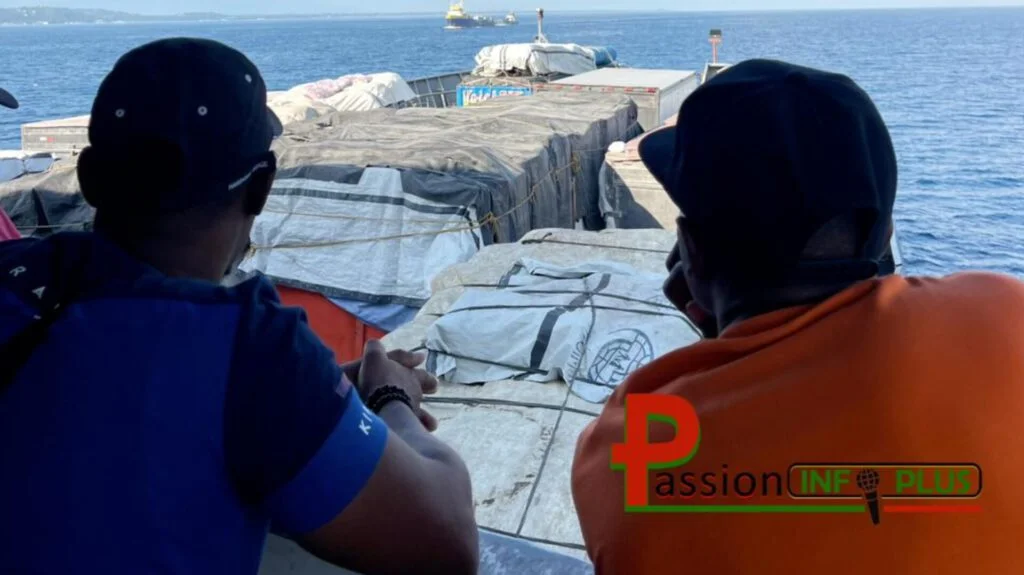
On board a multi-level vessel, containers of various sizes, cargo trucks, minibuses fully loaded with goods, cars, among others, are arranged under the supervision of controllers. According to available information, the fees for different vehicles range between 550 and 2,600 US dollars. On the other hand, there is no cost for the thousands of citizens who now use this means of transport to travel between the capital and the Grand Sud.
Each boat has its turn, and each driver has their clientele. Sailors, workers, and racketeers are all present in this new, highly sought-after sector, driven by the blockage of RN#2 by armed criminal gangs.
On board the vessel
The ropes and large chains are released. The bow ramp is lifted from the ground. The great journey begins on the horizon. From the APN to the port of Petit-Goâve, the sea journey lasts between 4 and 5 hours. Inside, a family-like atmosphere prevails. Vendors tend to their businesses. On this multi-level vessel, there is a mini-restaurant where passengers can buy food and drinks. Police officers and other armed individuals without uniforms were also observed on board.
For information, upon leaving the port, the vessel is escorted by a Coast Guard boat until it passes near the shores of Village de Dieu.
A sick passenger on board
Among the passengers was an elderly woman in poor health following surgery performed in the capital. Despite her condition, she insisted on returning home to Jérémie.
“My mother had surgery a week ago. Her condition is still unstable, but she refuses to stay any longer,” said John, her son, noting that he and his uncle, who was also present, had no choice but to follow her wishes.
“The doctors still gave us prescriptions so we can continue her treatment at a hospital in Les Cayes. My mother is very stubborn,” he added, declining to disclose the illness.
To arrange this highly complex transport to the APN, her relatives used a SWAT armored vehicle through a personal contact. They praised the help and patience of these specialized agents, hoping for the road to reopen soon.
In the open sea
More than two hours after departure, the vessel reaches the open sea. The journey goes smoothly. The sound of the engine is barely audible, and the boat’s movement is hardly felt, except when encountering large waves that shake the vessel and unsettle passengers. The trip feels increasingly long. Some people rest on simple blankets, others gather along the edges to contemplate nature while debating, and some pace back and forth, drinking alcohol to ease the tension—perhaps their first experience.
At this stage, maritime traffic becomes more fascinating, with encounters with several other boats coming from the ports of Carrefour, Petit-Goâve, Miragoâne, among others.
An alarming observation is made offshore: the presence of waste of all kinds. Plastic debris, in particular, floats on the sea. The marine environment is paying a heavy price for human neglect.
At 11:50 AM, the vessel approaches the city of Faustin Soulouque. Horns sound—the signal for other ships at the port to make way for docking.
Everyone begins to move quickly, as passengers must disembark before the trucks are unloaded, otherwise they will have to wait until the lengthy process is completed.
Once docking is complete, passengers rush to leave the vessel in single file. Meanwhile, hundreds of people are gathered at the port, welcoming new arrivals and offering various services.
The rest of the journey
Finally on land, everyone finds their own way to leave the secured area, monitored by a Coast Guard vessel and APN security agents.
A few meters from the port entrance lies a small public transport station. The minibus heading south costs 1,500 gourdes.
Twenty-one people, including an infant, squeeze into the vehicle, with their belongings piled on the roof. Far too many passengers for such a vehicle. The heat becomes oppressive, and travelers urge the driver to move.
Due to traffic jams caused by large containers and trucks—especially tanker trucks—heading to the port, along with numerous vendors occupying narrow streets, it takes more than 30 minutes to reach the National Road. The situation is clear: faced with this level of congestion, Petit-Goâve urgently needs to be rethought, particularly in terms of infrastructure.
Back on RN#2, the driver cannot take advantage of speed. The road is deformed in several places. Far from public attention, this once heavily traveled route now resembles a rural path.
Inside the minibus, passengers express frustration and impatience, as the journey is likely to take even longer. Authorities from the Ministry of Public Works, Transport, and Communications must be alerted to this alarming situation.
Additionally, RN#2 is occupied in several areas by public markets. Thousands of citizens occupy the roadway, risking serious accidents. The central government is aware of this.
In Miragoâne, everything is calm. The population goes about its business. Along the way, the vehicle is checked several times by law enforcement. In Deriso, “fritay” is still available, though prices have changed.
The journey continues. The scenery is not unpleasant. In Saint-Louis du Sud, the sea threatens the roadway, but its scent revives fond memories of the Grand Sud.
Traveling by sea is not appealing for the average person. Various risks are involved. Some citizens express reluctance to embark on such journeys, while others admit they have no choice—the situation demands it, especially in emergencies requiring their presence back home. One pressing question remains: when will National Road #2 be fully and sustainably reopened, serving as a vital link for part of the Ouest department, as well as Nippes, Sud-Est, Sud, Grand’Anse, and now even the eleventh department following modernization efforts at Antoine-Simon Airport in Les Cayes, Jacmel Airport, and potentially the port of Saint-Louis du Sud?