
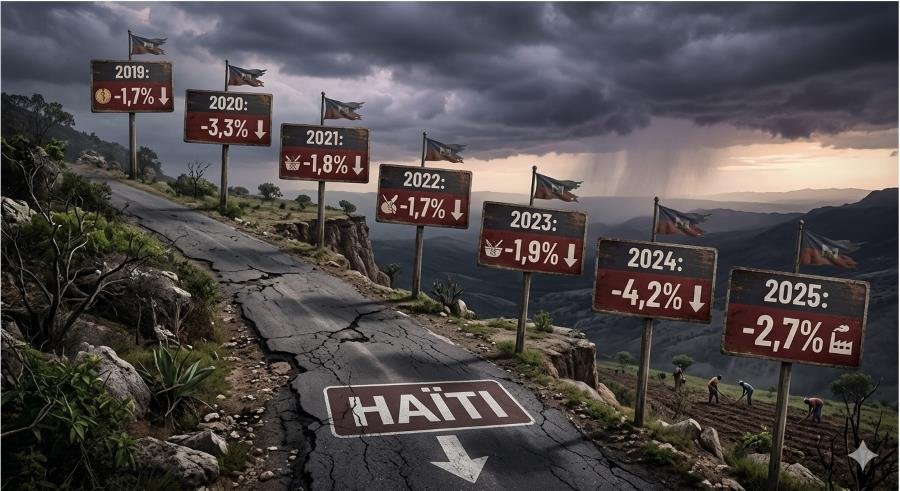
For about a decade, Haiti has been going through a period of deep political turmoil, exacerbated by the assassination of President Jovenel Moïse on July 7, 2021. Over these ten years, no elections have been held. At the same time, the national economy has continuously contracted over the past seven years. This amounts to a genuine economic depression with severe social repercussions. The political crisis and the economic downturn reinforce each other, plunging the country into a multidimensional crisis affecting institutions, governance, and living conditions. Widespread insecurity and the proliferation of armed gangs are direct manifestations of this dual crisis.
This is not a coincidence. There is a clear causal relationship between the political crisis and the economic depression. The collapse of political institutions weakens the State’s ability to design and implement coherent and effective economic policies. The absence of elections and the resulting legitimacy crisis reduce the predictability necessary for both domestic and foreign investment. This chronic uncertainty prevents capital accumulation, slows entrepreneurial activity, and accelerates both capital flight and brain drain.
In such a context, businesses hesitate to invest, development projects are delayed or abandoned, and investment flows—both domestic and international—decline. The formal economy contracts while informal and illicit activities expand.
At the same time, economic deterioration fuels the political crisis. Mass unemployment, loss of prospects, and widespread poverty undermine trust in public institutions. They create fertile ground for protest, violent mobilization, and the rise of non-state armed actors, which gradually replace the State in certain functions, particularly territorial control and resource exploitation. Insecurity is therefore not only a consequence of the political crisis; it also becomes an independent driver of economic disorganization, disrupting production, distribution, and exchange systems.
This vicious cycle creates a cumulative dynamic where each dimension of the crisis reinforces the other. The weakening of the State reduces its ability to ensure security and collect public revenues, further limiting its capacity to revive the economy or invest in essential services. As public services deteriorate, inequalities widen and social cohesion erodes, increasing overall fragility. Sectors such as health, education, and infrastructure clearly illustrate this decline.
Under these conditions, a real way out of the crisis cannot rely on a sectoral approach. It requires simultaneous reform of both political institutions and the country’s economic foundations. Without restoring political legitimacy, sustainable economic recovery will be difficult. Conversely, without economic recovery, the social foundations of political stability will remain fragile. Haiti’s crisis is therefore an entanglement of interdependent imbalances requiring a comprehensive, coordinated, and long-term response.
Added to this is the psychological and social impact of both crises. Persistent uncertainty fuels distrust among citizens, encourages emigration of skilled workers, and reduces confidence among international partners. The country thus enters a self-reinforcing cycle where political instability deepens economic depression, while worsening economic conditions intensify social tensions and political instability.
Understanding this interaction between politics and economics is essential to envision a sustainable exit from the crisis. Without restoring legitimate democratic institutions and a minimum level of political stability, it will be difficult to create conditions for durable economic recovery. Conversely, economic revival and job creation could help reduce social tensions and strengthen the foundations of more stable governance. In the absence of a credible electoral process, several key institutions are either dysfunctional or led by provisional authorities, further complicating effective decision-making and weakening the State’s capacity to meet urgent public needs.
The crucial role of institutions
The analytical framework presented highlights the interaction between institutional quality and economic policy performance. It shows that these two dimensions—though distinct—strongly interact in determining a country’s economic outcomes.
Two key elements are examined: the institutional framework, which can be either weak or strong, and the quality of economic policies, which can also be poor or effective. Institutions include formal and informal rules, norms, and organizations that shape economic life—such as rule of law, political stability, anti-corruption mechanisms, and administrative efficiency. Economic policies refer to fiscal, monetary, and trade decisions implemented by public authorities.
The combination of these dimensions leads to four possible outcomes. When weak institutions are paired with poor economic policies, the result is negative economic performance—low or negative growth, discouraged investment, and instability. This reflects Haiti’s experience over the past seven years. If institutions remain weak but policies are sound, performance remains mediocre, as good policies cannot fully offset institutional deficiencies.
Conversely, when institutions are strong but policies are inadequate, economic performance can still be relatively positive, as solid institutions help mitigate poor policy decisions. Finally, the combination of strong institutions and sound economic policies produces optimal performance, fostering growth, attracting investment, and improving living standards.
This framework highlights a fundamental lesson: strong institutions are a prerequisite for successful economic policy. Their interaction largely determines a country’s prosperity. Robust institutions—characterized by political stability, rule of law, transparency, and accountability—create an environment of trust that encourages investment, innovation, and efficient resource allocation.
Moreover, this relationship is dynamic. Strong institutions enable policy adaptation to shocks and structural changes, while effective policies can, in turn, strengthen institutions by reinforcing State legitimacy and public trust. This circular relationship shows that prosperity depends not only on technical economic choices but also on solid and inclusive institutional foundations.
Ultimately, any sustainable development strategy must place institutional strengthening at its core—not as a secondary objective, but as a fundamental condition for effective economic policy and long-term improvement in living standards.