
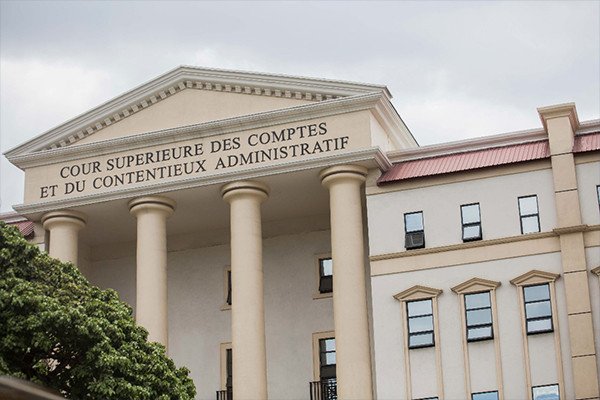
The Superior Court of Auditors and Administrative Disputes (CSCCA) has strictly criticized the Ministry of Economy and Finances (MEF) in its latest audit report for failing to comply with the Law of May 4, 2016, governing the preparation and execution of finance laws (LEELF). The oversight body indicated that the Ministry’s budgetary report focused solely on overall spending figures while failing to submit the mandatory General Accounts of the State—including the general balance sheet, income statements, cash flow charts, and off-balance-sheet commitments—stipulated under articles 57-b and 96 of the legislation.
On the revenue front, the CSCCA observed a strong performance in domestic revenue collection up to September 30, 2025. Customs duties hit a 92.04% achievement rate, domestic taxes reached 90.16%, and petroleum-related revenues topped projections at 102.56%. Current internal revenues served as the absolute backbone of public funding, covering over 82% of the total executed budget resources. However, overall revenue mobilization fell short of original targets at 74.62%, forcing the State to continually rely on short-term financing instruments by issuing Treasury Bonds worth 17.11 billion gourdes. Furthermore, macroeconomic goals went heavily off-track: the initial 19.1% inflation target missed its mark considerably, wrapping up the fiscal year at a staggering 31.9% according to central bank (BRH) data.
Regarding public expenditure, budget operations left a basic primary surplus of 14.97 billion gourdes, which ultimately turned into an overall deficit of 2.74 billion gourdes once financing costs were factored in. Although public spending on national programs and investment projects saw an upgrade—surging from 14.36% (15.96 billion gourdes) in the previous fiscal year to 40.52% (45.02 billion gourdes) by late September 2025—the Court deemed it insufficient to properly address the country’s economic recovery and social challenges. The most severe criticism focused on state subsidies and public transfers, which ballooned by 97% year-on-year. The CSCCA raised deep alarms over the complete lack of transparency surrounding these funds, noting that the MEF failed to include any metrics regarding social impact, coverage areas, or specific recipient registries.
To mend these financial fractures, the CSCCA put forward a series of urgent recommendations. It advised the government to push revenue collection efforts within the Customs (AGD) and Tax (DGI) directorates to enhance fiscal autonomy and reduce dependency on external loans. Additionally, it urged the executive branch to cut the administrative, logistical, and security red tape hindering public infrastructure works, mandate the publication of exhaustive itemized lists regarding subsidy beneficiaries, and channel funding toward social safety nets to protect vulnerable households facing soaring poverty rates and severe food insecurity.