
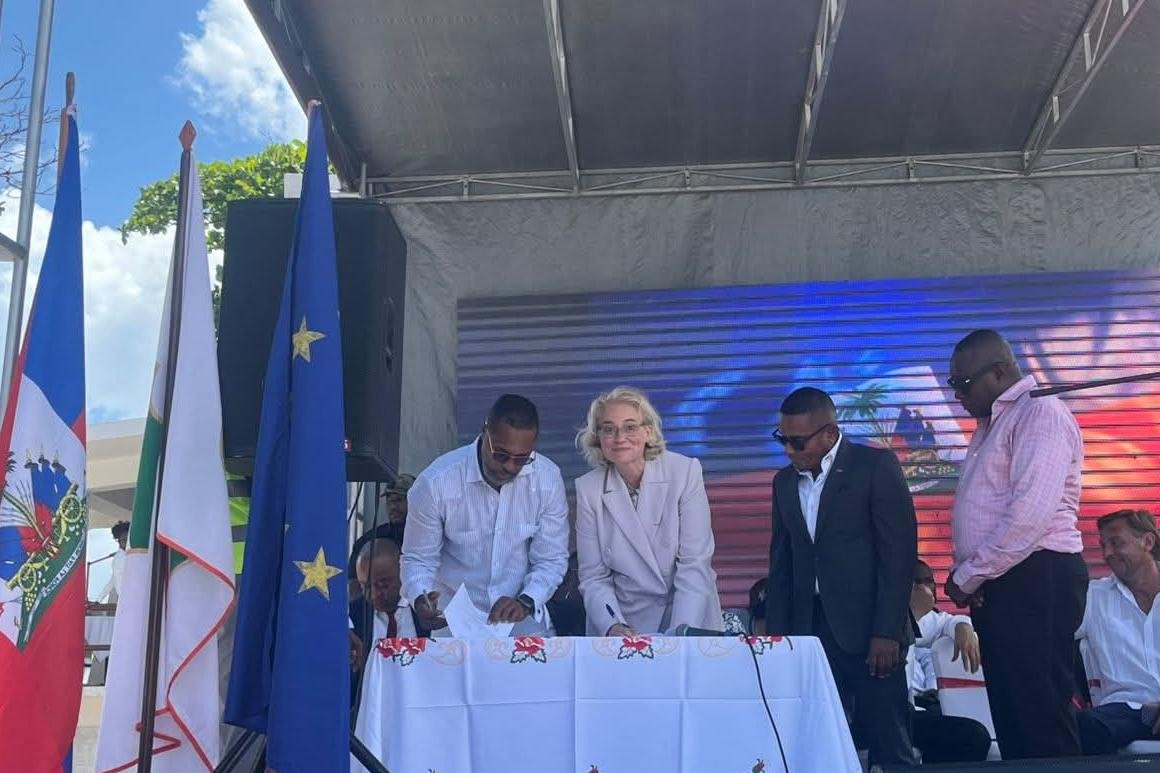
In a security and humanitarian context that remains highly volatile, ambassadors of the European Union, along with those of Spain and France, began a joint visit early this week to Haiti’s Southern department, scheduled to continue until April 13, 2026. This field mission aims to assess the progress of projects funded by the EU and its member states in the region.
“European ambassadors will take part in the inauguration, alongside Haitian authorities, of new infrastructure and the launch of new projects in southern Haiti, directly benefiting local communities.
A major project was launched on Tuesday, April 7, focusing on the implementation of integrated stormwater and river water management in the city of Les Cayes to help prevent flooding. A budget of nearly €10 million has been allocated for construction and supervision, implemented by the Office of the National Authorizing Officer,” the European Union delegation stated in a press release on Monday, April 6, 2026.
This project is part of the Urbayiti program, the EU’s urban initiative for Haiti, with a total budget of €56 million. “Another project focused on water and sanitation is funded by the EU with €3 million and co-financed by AECID with €1 million. It is being implemented under the leadership of DINEPA, through its regional offices OREPA West and OREPA South. Intervention areas include downtown Port-au-Prince, as well as the cities of Jérémie and Les Cayes. A total of €2 million will be invested in the Grand Sud,” the statement added.
Maternal and child health: addressing a silent crisis
Beyond water infrastructure, European cooperation is also tackling a silent health crisis affecting displaced populations. The TIMAMA ter project, funded by the French Development Agency (AFD) with €8 million, aims to strengthen the healthcare system in the South and Grand’Anse.
“This program is implemented by Entraide Médicale Internationale (EMI) in partnership with the Ministry of Health and funded by the AFD with €8 million in the Grand Sud. It includes the reconstruction of four maternity and pediatric units and the deployment of mobile clinics, enabling access to the most vulnerable populations. Care for victims of gender-based violence (GBV) is supported by an emergency hotline and local services offering medical, psychosocial, and legal assistance,” the statement emphasized.
Additional projects in agriculture, youth development, and child protection will also be presented during this mission week. Field visits are planned, allowing ambassadors to engage directly with beneficiaries and local implementing partners.