
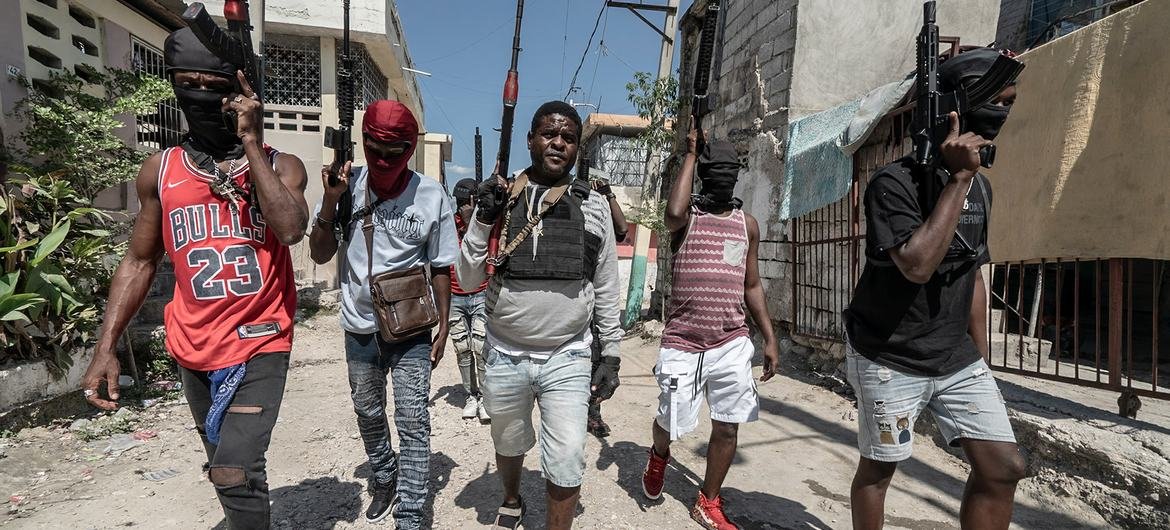
Gangs have continued to expand their grip in Haiti, notably by controlling key maritime and road routes, amid ongoing deadly violence, according to the United Nations Human Rights Office. The report notes that the violence also involves security forces, private security companies, and self-defense groups.
Over the past 12 months, gang violence has spread beyond the capital, Port-au-Prince, moving north into the Artibonite and Centre departments. According to the UN High Commissioner for Human Rights (OHCHR), this expansion has allowed gangs to secure strategic corridors and maintain control over critical land and maritime trafficking routes that sustain their financing and operations.
Killings and kidnappings
“By late January 2025, armed groups attacked Kenscoff, a mountainous area near Pétion-Ville and a secondary alternative route linking Port-au-Prince to the southern region that had previously escaped their control,” the report states.
As part of this expansion strategy, gangs have terrorized the population through killings, kidnappings, child trafficking, theft at illegal checkpoints, extortion of businesses, and the destruction of public and private property.
They have targeted individuals suspected of cooperating with police or challenging their authority. Some victims were executed, with bodies often burned. Others were subjected to gang-run “trials,” arbitrarily detained, and sometimes forced to pay fines for release.
“Gangs have continued to use sexual violence to instill fear, dominate, and punish the population,” the report adds, detailing severe abuses on a shocking scale.
More than 5,500 deaths
At least 5,519 people were killed in Haiti between March 1, 2025, and January 15, 2026, including at least 1,424 deaths directly attributed to gang violence.
Security operations against gangs resulted in at least 3,497 deaths and 1,742 injuries, while self-defense group attacks caused at least 598 deaths and 76 injuries.
Additionally, at least 1,571 women and girls were victims of sexual violence, mainly gang rapes, between March and December 2025. Some victims, including children, were forced into so-called “relationships” with gang members and subjected to prolonged sexual exploitation.
Police abuses and vigilante justice on the rise
The report also documents excessive use of force by police. Between March 2025 and January 2026, 247 cases of summary executions or attempted executions were recorded, resulting in 196 deaths and 51 injuries.
Violence is also carried out by self-defense groups and mobs engaging in “popular justice,” particularly within the Bwa Kale movement. Armed with stones, machetes, and increasingly firearms, these groups have lynched individuals suspected of gang affiliation or criminal activity. Some killings may have been encouraged or facilitated by police elements.
Drones and helicopters
Amid escalating violence and growing involvement of non-state actors, authorities have strengthened security operations using new methods.
Over the past year, a foreign private military company, “Vectus Global,” reportedly hired by the Haitian government, has participated in operations using drone strikes and helicopter fire. Some operations involved both national forces and the private company, while others were conducted solely by the latter.
“Some, if not most, of these drone strikes and helicopter operations could be considered targeted killings,” the report states, emphasizing that states are responsible for the actions of private military and security companies they employ.
Meanwhile, the UN Security Council has taken steps, including the creation of a new anti-gang task force. However, long-term effectiveness will depend on identifying, arresting, investigating, and prosecuting those who finance and support gang activities, in line with international standards.