
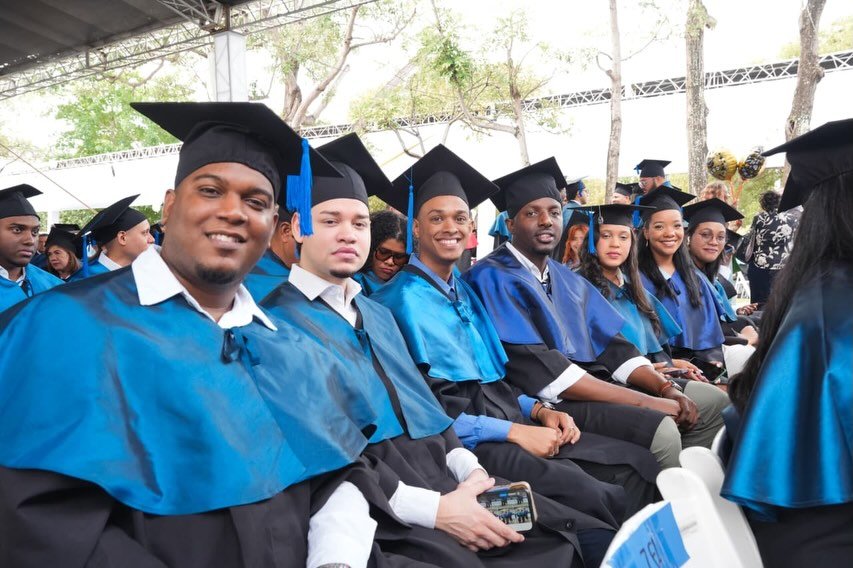
With more than 2,200 foreign students enrolled in its universities and total expenditures estimated at $44.5 million in 2024, the Dominican Republic is solidifying its position as a major academic destination in the region. Driven in particular by the attractiveness of its medical programs, this expanding model primarily draws Haitian students while rapidly diversifying with an international clientele that has stronger purchasing power.
The Dominican Republic continues to strengthen its role as a regional hub for higher education. According to data from the Central Bank of the Dominican Republic (BCRD), cited by the online media outlet Acento, the country hosts approximately 2,250 foreign students in its universities.
A 2023–2024 survey on foreign student expenditures reveals that Haitians account for 51.7% of all international students enrolled in Dominican universities, representing 1,163 individuals in absolute terms. Haitians therefore remain the largest group, although their share has declined by 20 percentage points since 2018. Meanwhile, American students now represent 21.9% of the total, with a growth of 31.1% over the same period.
These figures illustrate how the Dominican Republic is evolving from a model historically centered on Haitian students to a more diversified system, increasingly attracting higher-paying international students, particularly from the United States.
Between 2018 and 2024, Haitian student presence declined by 20%, while the number of American students increased significantly. This marks a structural shift in the composition of the international student population.
Among the 2,250 foreign students, Haitians are followed by 493 Americans, 210 Europeans, and 156 students from other countries in the Americas. The list also includes 142 Venezuelans, 52 Colombians, and 34 students from the rest of the world.
In 2024, international students spent a total of $44.5 million in the Dominican Republic. Of this amount, 74.1% went toward living expenses, while 25.9% covered academic fees, with an average monthly expenditure of $1,667 per student. Tuition costs average around $427 per month, though they vary significantly by nationality.
Haitian students account for approximately $23 million in total spending, compared to $9.7 million for American students. While Haitians spend more overall due to their higher numbers, American students spend significantly more on an individual basis—about 5.3 times more in tuition fees.
This confirms a shift toward a higher-income international student market. As the report highlights, American students spend an average of $898 per month on tuition, far exceeding Haitian students, who spend around $169.
They are followed by Colombians ($655), Europeans ($644), other American countries ($523), the rest of the world ($477), and Venezuelans ($377).
The March 2026 study also indicates that 59.1% of foreign students are enrolled in medical and health sciences. Engineering and fundamental sciences attract 19.8%, while 11% are in economics and administrative sciences. Social sciences, humanities, and arts account for 10.1%.
Medical fields clearly dominate, explaining both the high level of monthly expenditures and the strong attractiveness of Dominican universities. Students in health sciences spend approximately $1,272 on personal expenses and $484 on tuition.
The fact that nearly 60% of foreign students are in health-related fields—and that medicine alone accounts for 46.6% of enrollments—highlights the Dominican Republic’s emerging specialization as a regional training platform for medical education.
Different motivations, same destination
While medicine remains the main attraction, motivations differ. For Haitian students, the Dominican Republic offers relatively accessible medical education. For American students, it represents a more affordable alternative to medical schools in the United States.
Each Haitian student studying abroad represents not only a potential loss of human capital for Haiti but also a financial outflow, even if their individual tuition costs remain relatively low.
The dominance of Haitian students in medical and health sciences reflects a structural weakness in Haiti’s domestic higher education system—particularly in critical fields such as medicine, nursing, and dentistry.