

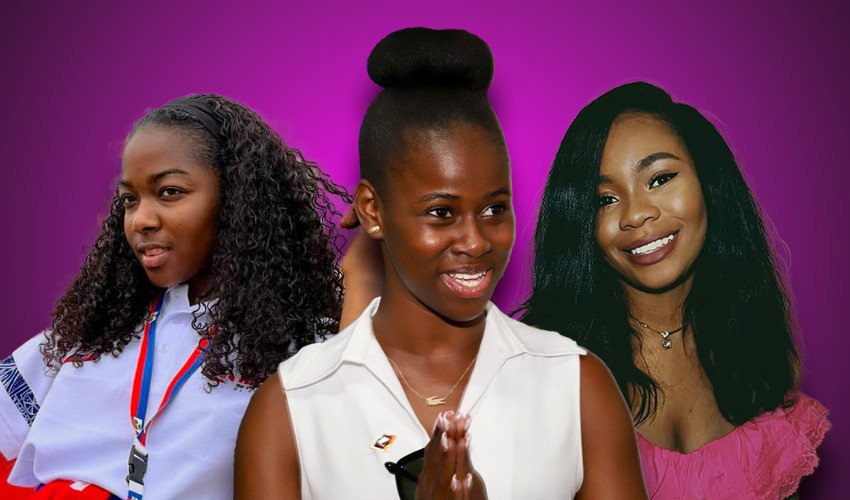
In a context often dominated by narratives of crisis, certain paths serve as a reminder that Haitian youth are not only resilient—they are creative, ambitious, and capable of making their mark on the international stage. The journeys of Ariana M. Lafond, Abigaïl Alexandre, and Milenchy Carthousia Pierre each illustrate, in their own way, the momentum of a generation that no longer endures, but acts, builds, and transforms.
Ariana M. Lafond embodies a connected, strategic, and bold generation. By representing Haiti in an international competition such as House of Challenge 2026 in Togo, she demonstrates that digital platforms are powerful tools for global visibility. Her ability to engage an audience, produce impactful content, and stand out in a competitive environment reflects a strong understanding of contemporary dynamics. Currently ranking first in the competition as of April 6, she proves that today, a young Haitian can start with limited resources and achieve global recognition—provided they combine discipline, consistency, and vision.
In contrast to the digital space but equally powerful in influence, Abigaïl Alexandre represents the strength of mastered speech. By winning the Eloquentia competition on March 25, she reminds us that speech remains a fundamental instrument of social transformation. The ability to argue, persuade, and captivate is a strategic skill in any society seeking progress. In a world saturated with images, she restores the value of oral expression and structured thought. Her journey not only highlights individual intelligence but also reaffirms education as a central pillar of change.
In the same pursuit of excellence, Milenchy Carthousia Pierre has made her mark in the Francophone academic sphere. A sociology student at the Université du Québec à Montréal, she won first prize on March 18, 2026, in a writing competition organized as part of Francophonie Month for international students. Her piece, “My country is,” goes beyond a literary exercise—it is an intellectual and identity-driven act. Through rich, sensitive, and rigorous writing, she offers a profound reflection on belonging, memory, and the diaspora. This distinction, awarded based on strict academic criteria such as language quality, originality, coherence, and depth, reflects true intellectual maturity.
But the essence lies not only in their individual achievements—it is in their collective impact. These three young women are reshaping the definition of Haitian success. They demonstrate that excellence can be expressed across diverse fields—digital media, public speaking, and writing—while pursuing a shared goal: to influence, inspire, and uplift. They become role models in an environment where positive examples are essential to shaping ambition.
Their impact is tangible. Ariana is paving the way for an entrepreneurial youth focused on digital innovation. Abigaïl is restoring the importance of critical thinking and the power of speech in civic development. Milenchy, for her part, is asserting the presence of Haitian intellectuals in international academic spaces. Together, they show that a country’s transformation does not necessarily begin with structural reforms, but with individuals capable of excelling and influencing their environment.
To Haitian youth: you are a generation of solutions. It is no longer just about dreaming or surviving, but about building, daring, and asserting yourselves. Transformation is already underway. The only question that remains is how many will choose to take part.