
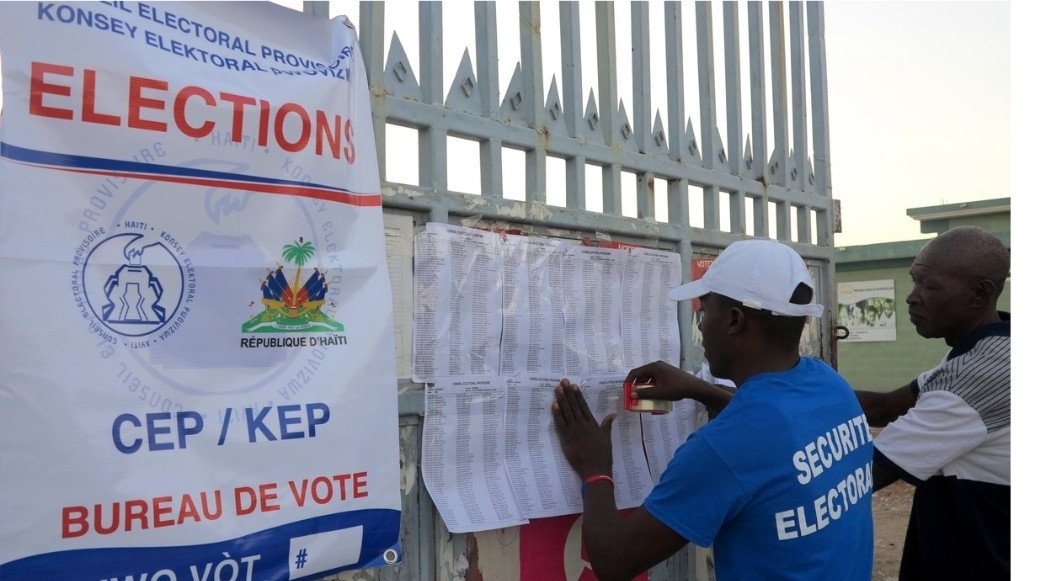
More than ten years have passed since the last elections in the country, within an environment marked by insecurity, social and economic instability. On May 14, 2026, the Ministry of Justice and Public Security organized a training session at the Hotel Montana for judicial actors and police officers in preparation for the upcoming elections. The activity brought together government prosecutors, deputies, justices of the peace, and police officers from the jurisdictions of Port-au-Prince, Petit-Goâve, and Croix-des-Bouquets.
Prime Minister Alix Didier Fils-Aimé set the tone during the opening, bluntly reaffirming his government’s determination to head to the polls. “We have no doubt that it is elections we are going to organize in the country,” he declared, announcing at the same time that he has mobilized all necessary resources to guarantee that the elections are held under the best possible conditions. “The money is there, the security apparatus and the judicial apparatus are hard at work,” he stated, showing himself ready to hold the elections come what may.
“Without security, no possible election is credible, and without justice, no democracy is sustainable,” he affirmed, welcoming this training launched for twenty jurisdictions across the country to strengthen the mission and role of the judicial and security apparatus in holding elections. On this front, the Prime Minister stated that “3 billion gourdes have been unlocked for political parties. From 2021 to the present day, the State has mobilized 50 million US dollars to support electoral operations.” For his part, the president of the Provisional Electoral Council (CEP), Jacques Desrosiers, outlined the central role played by judicial and police actors in holding a democratic vote. “For the ballot to be stronger than violence, for the verdict of the ballot box to be respected, a true synergy must be created between you, judicial actors, and actors of the national police,” he pleaded before the audience.
The president of the CEP also insisted on the urgency of restoring confidence to a youth that has never voted. “Someone who is 25 years old today was 15 during the last elections in 2016. Ten years without an election. Hope is almost destroyed,” he recalled with gravity, before concluding that the magistrates and police officers present are, through their commitment, “the guardians of hope.”
Furthermore, the Minister of Justice and Public Security, Patrick Pelissier, stressed that “this is an essential step to renew the institutional landscape, but above all to restore to the people their rightful place in steering their destiny.” Ten years without elections means leaving the people, who are the masters of the game, out of all political decisions in the country. He took the opportunity to detail the instructions sent to his ministry to support the electoral process. He announced that this training, organized first in the jurisdictions of Port-au-Prince, Petit-Goâve, and Croix-des-Bouquets, “will be reproduced across several other jurisdictions in the country.”
The minister also mentioned the measures taken to clean up the electoral environment, notably with the establishment of two special courts, “specialized judicial hubs,” equipped with competence to judge gang crimes and acts of complicity, as well as a mission aiming to “judge financial crimes and prevent money from kidnapping and corruption from financing electoral campaigns.”
“This year, we will have criminal court sessions with jury assistance,” he announced. These sessions have not taken place since gangs took control of the court of first instance of Port-au-Prince. “In 2018, there were people who had already been waiting ten years for trial. This year, those people who have not been tried have been waiting for almost eighteen years,” he stated, while revealing that the preparation of two large courtrooms is planned to give these people access to justice.
From the start, the government has not stopped reminding everyone of its priorities: security, economic stability, and holding elections. The government has promised free, inclusive, and secure elections. It remains to be seen how the people will respond to this call, particularly those located in the lost territories.